Home » Solutions to Learning Poverty
Solutions to Learning Poverty
2019 Nobel Prize winning economist, professor Michael Kremer and co-authors’ ground-breaking study into NewGlobe’s methodology in an African programme reveals learning gains among the largest ever measured in international education.

The methodology studied in NewGlobe’s Kenya programme is largely the same methodology that underpins JigawaUNITE.
Extract from study:
“The effects in this study are among the largest in the international education literature, particularly for a program that was already operating at scale.”
“This study shows that attending schools delivering highly standardized education has the potential to produce dramatic learning gains at scale, suggesting that policymakers may wish to explore incorporation of standardization, including standardized lesson plans and teacher feedback and monitoring, in their own systems.”
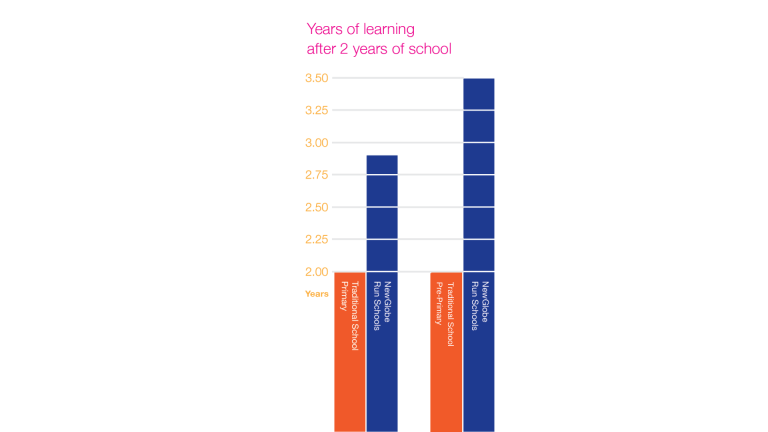
Professor Michael Kremer and his co-authors observed that students in primary through lower secondary school participating in NewGlobe’s program in Kenya progressed nearly an additional academic year (0.89) thanks to NewGlobe’s integrated methodology. They acquired in two years what their peers in other schools took almost three years to learn.
For pre-primary school students, the results are even more remarkable. Students supported by NewGlobe record almost an extra year and a half of learning (1.48), assimilating in two years what students in other schools learn in three and a half years.
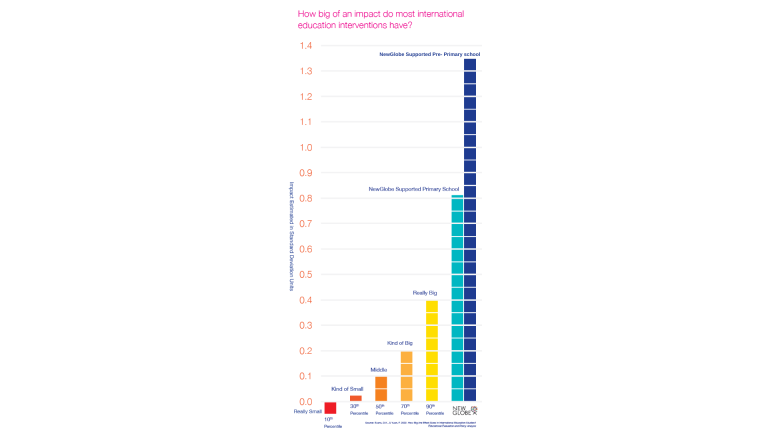
NewGlobe’s methods resulted in an increase in learning equivalent to 1.35 standard deviations for preschool students and 0.81 standard deviations for elementary through high school students.
To put these results in perspective, these effects extend well beyond the 99th percentile, representing learning gains among the highest 1% observed in large, rigorous studies in emerging markets.
Key Facts:
- After two years, primary pupils, up to Junior Secondary School taught using NewGlobe’s full learning system are nearly a whole additional year ahead of pupils in other schools taught using ordinary methods – with learning increased by 0.81 standard deviations.
- For Pre-primary pupils, two years of teaching using NewGlobe’s methods puts them a year-and-a-half of additional learning ahead of pupils in other schools – with learning levels increased by a remarkable 1.35 standard deviations.
- In NewGlobe-supported schools, 82% of Primary 1 pupils – typically six to seven-year-olds – can read a sentence, compared with 27% of those in other schools.
- Learning gains were greatest for pupils predicted to have the lowest performance who outperformed similar pupils attending other schools by a larger margin than their more advantaged peers.
- Girls make the same leap in learning as boys.
This two-year study is based on a large-scale randomized control trial (RCT) involving more than 10,000 students from disadvantaged socioeconomic backgrounds.